


Welcome to Issue 11 of the China AI Bulletin, the latest on AI governance, development, and safety in China. Today’s highlights: the Supreme People’s Court (SPC) issued adjudication rules for AI disputes, the Cyberspace Administration of China (CAC) flagged AI loss of control and bio misuse risks, and Huawei announces its new Kirin 9050 Pro chip.
Number of the week: 24.3 percent—the share of correct content moderation decisions that are reversed when a Chinese text is rewritten using variant characters that read the same to a person.
Executive Summary
The SPC issued China’s first nationwide adjudication rules for AI disputes. The rules allocate responsibility among providers, developers, users, and manufacturers of autonomous systems without resolving copyright in AI outputs or training.
The CAC, the regulator for public-facing AI and online services, placed extreme loss of control and biological misuse among five major AI risks.1 Its Qinglang campaign also shifted from model and service compliance to AI-generated content and conduct, which includes impersonation, false information, and automated fake engagement.
The US National Security Agency, Cybersecurity and Infrastructure Security Agency, and Federal Bureau of Investigation accused six Chinese artificial intelligence (AI) companies of industrial-scale distillation through proxy services via a joint cybersecurity advisory. Foreign Ministry Spokesperson Mao Ning rejected the allegations and called for cooperation, although she said she had not seen the advisory.
The G20—including China—adopted the US-backed Carolina Principles encouraging lighter, sector-specific regulation. Xiao Qian and Yuyuan Tantian separately proposed a narrower bilateral agenda focused on dangerous capabilities, incident channels, joint testing, and reciprocal rules; neither commentary states an official negotiating position.
Models and Lab Developments: Chinese lab-affiliated authors released 214 papers on arXiv this fortnight.
Notable Model Releases: Tencent released the 770-billion-parameter Hy4-preview; Zhipu published GLM-5.3 weights after its safety delay; and DeepSeek released DeepSeek-V4-Flash-Vision-Exp weights.
Frontier Lab Developments: Huawei researcher Tingbo He says restricted access to extreme ultraviolet lithography led Huawei to use wafer-to-wafer three-dimensional logic stacking in the Kirin 9050 Pro. HarmonyOS 7 adds kernel-level agent support to Huawei’s operating system.
Technical Papers: ByteDance’s HarnessDev found that agent harnesses built by models matched human-engineered systems on some tasks but transferred unreliably across tasks. Huawei researchers also analyzed DeepSeek-V4-Flash, finding that mixing between residual streams in later layers was largely redundant.
Technical AI Safety Publications: Chinese institutional authors released 78 safety-related papers, roughly half of them on agents.
Export Controls & Economic Policy:
The Ministry of Commerce required provisional anti-dumping security deposits of 80.8–99.2 percent on Japanese dichlorosilane, an upstream input for logic, memory, and analog chips.
The Standardization Administration of China published 42 nonbinding AI and brain-inspired computing documents, including guidance on agents, embodied intelligence data, retrieval-augmented generation, and industry deployments.
The National Technical Committee on Cybersecurity Standardization, TC260, opened comment on a five-level AI security maturity assessment.
The State Administration for Market Regulation registered three projects on AI ethics review institutions and procedures.
Domestic AI Governance
The CAC references extreme loss of control and AI bio risks
Wang Lihong, deputy director-general of the Cybersecurity Coordination Bureau at the Cyberspace Administration of China (CAC), named five major AI security risks at a September 1 press conference: (1) technical vulnerabilities and unreliable outputs; (2) capability gains and “extreme loss of control”; (3) agents with high system privileges; (40 misuse, including in biology and genetics; and (5) “technological hegemony.” The CAC is China’s lead regulator for public-facing generative AI and online services. It led the seven-agency Interim Measures for Generative Artificial Intelligence Services and administers model filing and application registration; Wang’s remarks therefore carry more weight than academic or state-media commentary.
“Extreme loss of control” most closely resembles Western AI safety concerns, but the term remains ambiguous. As Zilan Qian explains, 失控 (shikong) can mean that a user loses control of an agent, the state loses control of a socially important system, or humanity loses control of advanced AI. Wang obliquely referenced the spate of recent AI cyber-incidents, and her references to rapid capability gains, frontier models, and systems defeating human-imposed controls come closer to the third definition than earlier references to malfunctioning systems or excessive agent permissions.
Wang also placed biology and genetics within AI misuse, seemingly the first time for the CAC. She said AI could lower barriers to ethically risky research and lead researchers to cross ethical boundaries, without specifically naming pathogen design, bioweapons, or harmful genetic engineering. Chinese binding instruments have rarely connected AI with biological misuse. The Biosecurity Law does not mention AI, although the nonbinding AI Safety Governance Framework 2.0 includes biological weapons in a broader risk category. Her agent concerns follow the CAC’s May policy on agent development and use, while “technological hegemony” echoes Xi Jinping’s opposition to overextending national security in AI and concerns in state media on US controls.
Though Wang did not lay out specific plans to regulate these risks, it’s a notable statement of concern and a possible indicator of regulatory direction from China’s primary AI regulator.
China’s top court sets rules for AI disputes
China’s Supreme People’s Court (SPC) has issued the country’s first nationwide adjudication rules for disputes involving artificial intelligence. The Opinions on Lawfully Adjudicating Disputes Involving Artificial Intelligence, released September 7, tell courts how to apply existing law to AI disputes. The Opinions are neither legislation nor a formal judicial interpretation, so courts must still base judgments on the Civil Code or another binding law. They will nonetheless shape decisions nationwide: the SPC’s rules allow courts to cite this type of guidance in their reasoning, and the Opinions direct higher courts to supervise cases that could establish new rules. The SPC previewed the work in the spring; an official confirmed the drafting process in April, and the Intellectual Property Court held a two-part open source AI governance roundtable in May (part one; part two).
The new Opinions reject blanket strict liability for generative AI. Courts will instead ask whether a developer, provider, or user was at fault given the application’s risks, the system’s autonomy, the precautions available, and each actor’s control over the harm (Article 3). Providers must also act after receiving a substantiated infringement notice, although the drafters dropped a broader duty to identify obvious infringements without notice after commenters raised the monitoring burden (Article 7). Existing strict product liability still applies to defective robots and autonomous vehicles, but not to standalone generative AI services. (In contrast, the EU’s revised Product Liability Directive will treat software itself as a product from December 9, 2026.)
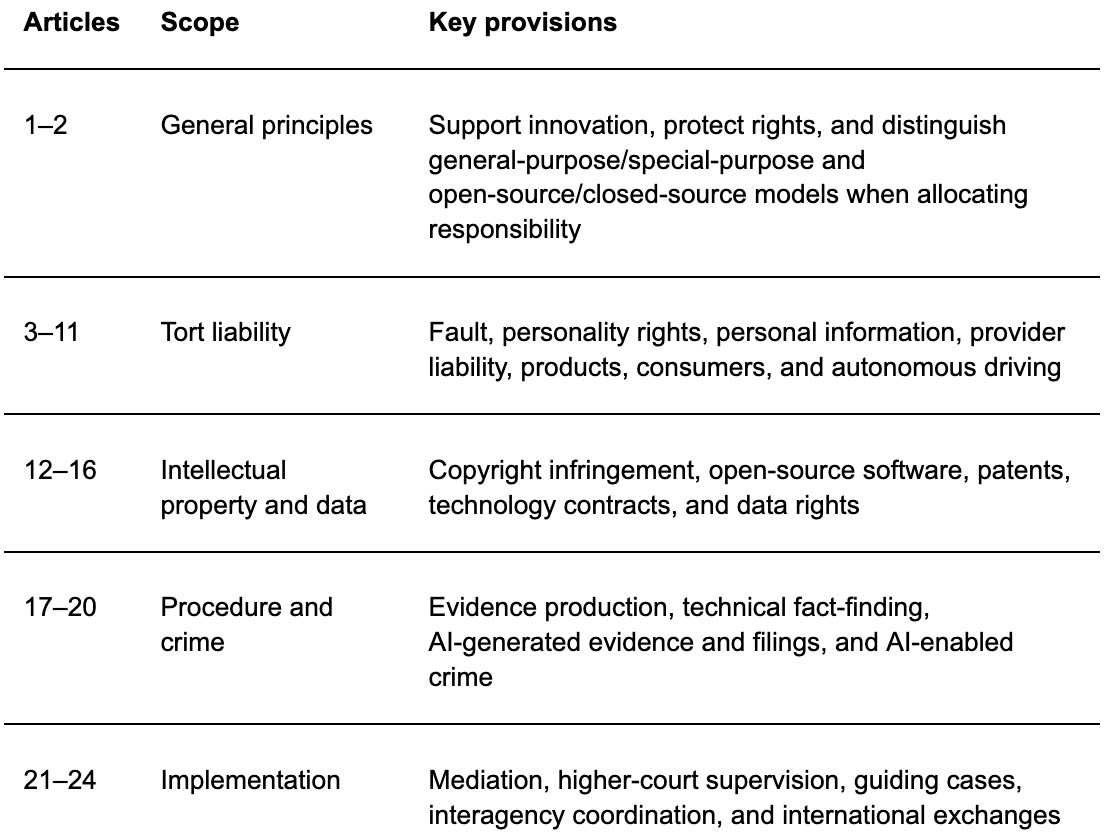
The Opinions also address harms prominent in Chinese policy debates. Courts may hold people liable for using AI for doxxing through “online box-opening” (网络开盒) or “human-flesh searches” (人肉搜索), as well as for unauthorized face-swapping, voice imitation, and digital “revival” of deceased people (Articles 4–5). Developers defending copyright claims may have to disclose information about their training data and model operation (Article 12). Free open-source code developers may avoid liability for downstream infringement if they explain the code’s functions and risks, although the provision does not clearly cover releases of model weights (Article 13).
The SPC left two major copyright questions unresolved: whether AI-generated material can be copyrighted and whether developers may train on copyrighted works without permission. Its drafters said both questions produced substantial disagreement, so it was left to future cases or a later judicial interpretation.
The CAC opens phase two of AI “chaos” cleanup
The CAC reported on the second phase of its Qinglang campaign against AI application “chaos” on September 2. Qinglang (清朗, “clear and bright”) is the CAC’s umbrella series of time-limited online enforcement campaigns. The four-month AI campaign, announced in April, divides enforcement between the services that produce AI outputs and the content that users and platforms distribute. We covered the campaign’s design in Issue 4 and its first-phase results in Issue 8.
Phase One focused upstream on AI services: models operating without required filings, weak safety review and content filtering, unsafe training corpora, data poisoning, missing labels on AI-generated content, AI-enabled illegal activity, and poor security management of open source models. In July, the CAC said authorities had handled more than 14,000 non-compliant websites, apps, and agents; removed more than 1,300 AI products and nine open source datasets; cleared more than 6 million pieces of information; and acted against more than 26,000 accounts. Platforms also added filing checks, content filters, data poisoning detection, and safeguards against malicious code generation.
Phase Two moves downstream to seven categories of AI-generated content and conduct: low quality “digital slop” (数字泔水) and AI remixes of classic works; false information; impersonation; violent or vulgar material; harm to minors; AI-operated “water armies” (网络水军) that simulate users and engagement; and noncompliant AI products and apps. The CAC said authorities had removed more than 5.61 million items, acted against more than 49,000 accounts, and handled more than 2,400 websites and apps during this phase. It also said that platforms have expanded face, voiceprint, and multimodal detection, and app stores have tightened developer checks. Phase One targeted model and service compliance; Phase Two applies existing rules to AI-generated material and its distribution through platform inspections, removals, account penalties, and app store enforcement.
Qiushi discusses gaps in China’s AI-for-science push
On September 1, Qiushi published Chen Kaihua’s “How Artificial Intelligence Can Lead the Transformation of the Scientific Research Paradigm”. Chen is a Distinguished Professor at the University of Chinese Academy of Sciences (UCAS), a researcher at the Chinese Academy of Sciences’ Institutes of Science and Development, and deputy director of UCAS’s National Center for Frontier Technology Integration and Innovation. He argues that generative AI, multimodal models, and agents could reorganize research, but a number of factors hold China back from achieving this: research compute is insufficient and unevenly distributed; scientific data remains fragmented; universities and funding systems impede interdisciplinary work; and the country lacks an integrated system linking researchers, companies, platforms, and open source communities. He calls for national compute scheduling and scientific data networks, scientific foundation models, autonomous laboratories, open source infrastructure, and reforms to research funding and evaluation.
China has pursued AI for science for several years. The Ministry of Science and Technology and the National Natural Science Foundation of China launched a dedicated program in 2023, and the State Council made “AI+ science and technology” the first of six tracks in its 2025 AI+ opinion. Beijing’s 2026–2028 plan includes 18 tasks covering autonomous laboratories, research agents, scientific models, data, and compute. Chinese labs have already built systems such as the University of Science and Technology of China’s “machine chemist,” which synthesized an oxygen-evolution catalyst from Martian meteorite material without human intervention (Nature Synthesis, 2023), and the Shanghai AI Lab’s 397-billion-parameter Intern-S2-Preview model for science and long-horizon agents, covered in Issue 8.5. Chen identifies coordination and infrastructure as the remaining bottlenecks. He also describes the US Genesis Mission as a Manhattan Project-scale mobilization that could create a new “technology iron curtain,” connecting AI for science to the CAC’s Wang Lihong’s concern about US “technological hegemony.”
International AI Governance
China rejects a new US distillation advisory
The US National Security Agency, Cybersecurity and Infrastructure Security Agency, and Federal Bureau of Investigation accused six Chinese AI companies—DeepSeek, Moonshot, Alibaba, MiniMax, StepFun, and Zhipu—of conducting “industrial-scale” knowledge distillation against Claude, GPT, Gemini, and Grok. It alleges that the companies extracted billions of tokens through millions of requests beginning in late 2024, “likely with Chinese government awareness.” The agencies acknowledge that distillation is a standard and legitimate training method but allege that the companies conducted it at scale by evading providers’ access controls.
The advisory says the companies route requests through a gray market of application programming interface (API) proxies it calls “transfer stations” (中转站) to bypass US providers’ regional limits and terms of use. Chinese authorities have warned individual users, though not companies, against these services. TC260 advises users to choose filed models and avoid unknown relay stations or unauthorized proxies, while the Ministry of State Security (MSS) has warned that overseas AI proxies can expose data and credentials.2
Foreign Ministry Spokesperson Mao Ning rejected the allegations on September 9, although she said she had not seen the advisory. She called China’s AI progress “the fruit of high-level scientific and technological self-reliance,” urged the US to stop making “untrue accusations and smears,” and said the two countries should strengthen AI cooperation.3 None of the six companies had responded publicly as of September 9.
The G20 adopts US framework for lighter AI rules
The G20 Innovation ministers meeting in Chapel Hill, North Carolina, on September 1 and 2 adopted the Carolina Principles for Emerging Technologies, a nonbinding framework introduced at the summit. The Principles recommend using existing sector-specific regulation where possible and limiting new rules to gaps those frameworks cannot address, while warning that inflexible regulation can restrict innovation. However, provisions on national circumstances and sovereign policy frameworks leave governments broad discretion over implementation.
Though China agreed to the joint statement, which contains the Carolina Principles, China’s readouts don’t mention it. China’s Ministry of Science and Technology reported “numerous consensuses” on AI and emerging-technology policy,4 while the Ministry of Commerce (MOFCOM) says only the ministers issued a joint statement.
The ministerial combined science-and-technology and commerce-focused sessions and produced a single six-pillar statement. In the commerce sessions—covering intellectual property policy for AI innovation, AI and standards, and supply-chain investment—Vice Minister of Commerce Jiang Chenghua called for the United Nations to hold the “main channel” position in AI standard-setting, described open source as AI’s “inherent gene” and a route across the “digital-intelligence divide,” and supported sharing research results alongside protecting intellectual property.5 The final statement overlaps with some of these positions: it endorses open, fair, and nondiscriminatory standards and links intellectual-property protection to disseminating knowledge. But it mentions neither the United Nations nor open source and frames standards chiefly as supporting market competition and avoiding trade barriers.
Alongside the summit, US Office of Science and Technology Policy (OSTP)6 Director and S&T advisor Michael Kratsios met with China’s S&T Minister, Yin Hejun, and described the meeting positively.
Chinese commentators propose a narrow US–China AI safety agenda
Two Chinese commentaries published as the US and China prepare for a reported September AI dialogue propose starting with practical measures rather than a broad agreement. Xiao Qian, deputy director of Tsinghua University’s Center for International Security and Strategy, argues in Foreign Policy magazine for confidence-building measures around AI-enabled cyberattacks on critical infrastructure, major model failures, and other cross-border incidents. Her proposals include protected categories of critical infrastructure, voluntary “negative lists” for AI-enabled cyber activity, compatible provenance and watermarking systems, shared responses to fraud and disinformation, vulnerability notifications, and designated government emergency contacts.
Yuyuan Tantian, an unofficial commentary account of China Central Television (CCTV) under China Media Group,7 takes a more confrontational position. Its commentary, “Anthropic has Caught America’s Disease,”8 attacks Anthropic and argues that no US company should have unilateral authority to define dangerous models. It supports joint testing and restrictions for capabilities that could cause severe harm only if both (1) countries agree on a scientific definition, (2) apply the rules equally to US and Chinese companies, and (3) independently audit the assessment mechanisms. It argues that normal model research and commercial use should not face secret interference, and that the line separating those from capabilities that could cause serious harm must be drawn by the participating parties together.
While both commentaries advocate narrowly defined dangerous capabilities, joint testing, reciprocal rules, and incident channels, neither presents an official negotiating position.
Other international governance news
The Organisation for the Prohibition of Chemical Weapons (OPCW), the Ministry of Industry and Information Technology (MIIT), and the Zhejiang provincial government held a four-day course on AI and chemical safety and security in Hangzhou. It seemed to be more about using AI to prevent human misuse of chemical weapons than AI CBRN risks but could be a venue to discuss these risks in the future.
Assistant Foreign Minister Liu Bin opened China’s fourth AI capacity-building seminar at Peking University on September 7, with representatives from more than 30 countries. Liu warned that monopolies over AI resources could deepen global digital and wealth gaps and argued that capacity building should give developing countries the underlying capabilities to develop AI autonomously, apply it to local problems, and build governance capacity alongside technical capacity.
Frontier Lab Developments
Huawei unveils its first LogicFolding Kirin chip
Huawei introduced the Kirin 9050 Pro at its September 7 launch for the Mate XT 2. The Mate XT 2 product page describes the processor and attributes a 42 percent increase in whole-device performance over the previous model for combined optimization across the chip, hardware, software, and cloud services.
Huawei describes the 9050 Pro as its first LogicFolding τ chip. IT Home reports that the design stacks logic units in layers and connects them vertically to shorten signal paths. The only technical account of the architecture is a paper posted to arXiv on September 3 by Tingbo He of Huawei. It states that they took this approach because scaling below the 7-nanometer node requires extreme ultraviolet lithography, “which cannot be accessed” (due to export controls) so “another way had to be found.” That method is wafer-to-wafer 3D hybrid bonding, which the paper treats as a wafer-level device step rather than packaging, with two wafers annealed until the oxide bonds covalently and the copper pads fuse. Huawei folds the NPU, GPU, CPU, and DSP across two tiers of silicon, turning long horizontal routes into short vertical hops.
The paper reports a 1.5-micrometer bonding pitch achieved on 40-nanometer tooling, 50 million vertical interconnects, and transistor density rising from 155 to 238 million per square millimeter, a 55 percent gain the paper says matches what three prior years of geometric shrinking delivered. Against the planar Kirin 9030 Pro at matched performance, it claims the NPU draws 66 percent less power, the GPU 58 percent less, and the CPU performance core 41 percent less; run at full power instead, the same NPU reaches 70 TOPS against the predecessor’s 29. However, these are all self-reported in a single-author corporate paper, so should be taken with a grain of salt.
HarmonyOS 7 makes agents part of the operating system
Huawei is integrating agent coordination into its operating system. HarmonyOS 7, released September 7, introduces an “agent-affinity system architecture” that supports agents from the kernel.9 Huawei says the operating system can infer what a user is trying to do and allocate system resources. It describes the result as a shift from users finding individual applications to “intent as a service.”
Kernel-level agent support places agent permissions inside the operating system’s security boundary. As discussed above, Wang Lihong of the CAC identified endpoint agents as a major AI risk because they can reach sensitive device functions and data. HarmonyOS 7 fits that deployment model, although the timing does not show that Huawei was responding to the CAC. Huawei has not published enough detail about its permission and isolation design to assess the risk.
Qiushi repeatedly publishes Zhipu co-founder’s views
Qiushi’s website published a video interview with Tang Jie, a Tsinghua University professor and Zhipu co-founder and chief scientist, on September 3. Tang said Chinese models were narrowing the gap with global leaders in question answering and search but that leading foreign models had moved further into coding and long-horizon tasks. He presented open source as China’s best route to a distinctive advantage, while identifying shortages of advanced chips and high-quality data, and a lack of original theoretical breakthroughs, as continuing constraints. He also said models surpassing individual human intelligence were inevitable, although whether they could exceed humanity’s collective intelligence remained open. Geopolitechs provides an English transcript.
Qiushi’s website previously interviewed iFlytek chairman Liu Qingfeng about Chinese AI in 2025 and 2026, and posted another Tang interview on August 21. It has given Tang sustained attention: the print magazine carried his essay on tokens and the intelligent economy on August 16, followed by several website and video treatments over the next three weeks, providing an unusual level of visibility for a commercial lab leader.
Models
Tencent released Hy4-preview on August 27 as an open-weight preview of its next Hunyuan flagship. The Apache 2.0 model has 770 billion total parameters, 49 billion active parameters, and a 1 million-token context window. Tencent reports that Hy4 narrowly outscored GLM-5.3 and Kimi K3 in a blind evaluation by 163 company employees across 203 work tasks (although this was a purely internal test). The model card notes that this is an early version of the model: “there is real headroom left in both pre-training and post-training, and we are shipping with known issues,” including over-reasoning and repeat verification of its own work.
Zhipu made GLM-5.3 weights available on August 28 after delaying them for roughly two weeks to complete safety evaluations. This completes the staged release covered in Issue 10; both the main checkpoint and a higher-precision BF16 version are now available. The model card reports 84.5 on CyberGym and 54.4 on ExploitBench, but it does not explain what the safety evaluation found or whether Zhipu changed the model before release.
DeepSeek released DeepSeek-V4-Flash-Vision-Exp weights on August 31 under an MIT license, following the API-only release covered in Issue 10. DeepSeek calls it the first experimental multimodal model in the V4 family and reports better multimodal-agent results than V4-Flash-0731 with similar text performance. Its text-agent scores use DeepSeek’s own harness, so those results depend partly on the company’s agent runtime and configuration.
Alibaba released Qwen-Drive-1.0, a 4-billion-parameter autonomous-driving model, under Apache 2.0. It leaves the Qwen3.5 vision-language backbone unchanged and adds a bird’s-eye-view perception head for 3D detection and mapping and a Planning Expert that predicts the vehicle’s future path. The base model can still answer free-form questions about a driving scene. The release coincides with public comment on a national standard for constructing safety boundaries in emergency driving scenarios and the first review of revisions to the Road Traffic Safety Law.
Tencent released ContextPilot-8B, ContextPilot-14B, and ContextPilot-E4B, together with code and a technical paper. ContextPilot trains agents to plan, maintain structured memory, and move information out of the active context window. Its reinforcement learning method evaluates intermediate context edits by the results of the later branches that use them. The 8B and 14B checkpoints use Alibaba’s Qwen3 weights; E4B uses Google’s Gemma 4.
Other releases:
EVIE-4.5B and EVIE-8B (Tencent), the full release on September 4 of the multilingual visual-document retrieval model previously released as a preview.
core-emb and core-reranker (Alibaba), a retrieval stack in 2-billion- and 8-billion-parameter sizes with a paper.
MiniMax-H3-Acc-LoRAs, acceleration adapters published by Alibaba’s PAI team for MiniMax’s model.
InternLumina-U2 (Shanghai AI Laboratory) is a unified multimodal model handling text QA, text-to-image generation, image understanding, instruction-based image editing, and video and 3D understanding through one backbone. Shanghai AI Lab reports 86.52 on ChartQA and 87.10 on DPG-Bench and claims it beats the understanding-only InternVL3-8B on two visual-math benchmarks. This is the first stage of release—the inference code is out now, with weights, training code, the Ascend stack, and the technical report all listed as forthcoming.
Qwen-Audio-3.0-ASR (Alibaba) is an instruction-following speech recognition system covering 30 languages and 16 Chinese dialects, domain-specific terminology, and long-form audio in a single pass. Alibaba reports that it matches or beats GPT-4o Transcribe and Gemini 3.1 Pro across multilingual and real-world benchmarks and it published a technical report. It ships as a commercial API on Alibaba Cloud Model Studio in streaming and file-transcription variants, with no open weights, unlike the smaller Qwen3-ASR line whose 0.6-billion- and 1.7-billion-parameter checkpoints are public.
TTSonic (ByteDance) is a demo page rather than a release. It presents a unified speech model that separates semantic and prosodic speech tokens from speaker timbre, combining a semantic tokenizer, a text-to-semantic autoregressive language model, and an acoustic flow-matching model. The advertised capabilities are zero-shot text-to-speech, voice cloning, prosody cloning, controllable cloning, text-guided voice design, and voice conversion.
Lab Publication Highlights
Frontier lab-affiliated authors released 214 papers on arXiv this fortnight. Highlights are below; a full list with summaries can be found here.
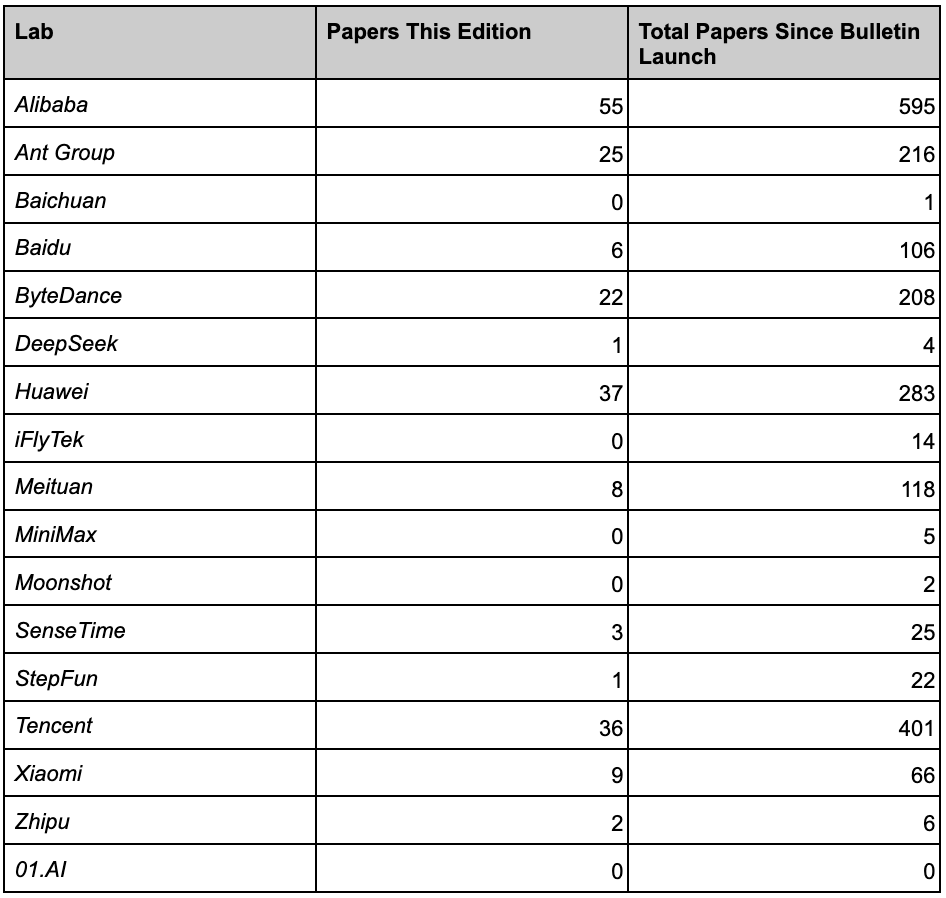
Alibaba
On the Design of Qwen3.8-Next Architecture: Evaluation, Efficiency, and Training Stability
Qwen3.8-Flash-Next is a sparse mixture-of-experts model that Alibaba reports matches a 397-billion-parameter predecessor while using a third of the activated parameters, a third of the training tokens, and a ninth of the training FLOPs, through hybrid token mixing that pairs gated delta networks with sparse attention, gated residual streams, and n-gram embeddings held off the accelerator. Alibaba also reports that loss and downstream accuracy do not always move together, and argues that optimizing efficiency, capability, and stability jointly gives a better architecture recipe. The weights ran in Issue 10, and Alibaba says this architecture is planned for Qwen4.
Baidu
oHC: Orthogonal Hyper-Connections on SO(4) via Quaternions
Orthogonal Hyper-Connections constrains the mixing matrix between parallel residual streams to rotations, using quaternions so the mixing step neither amplifies nor shrinks any direction, which prevents training instability. Baidu reports that it beats both prior hyper-connection variants and single-stream baselines across downstream tasks.
ByteDance
HarnessDev: Can LLMs Create and Evolve Their Own Agent Harness?
HarnessDev is a benchmark for whether language models can build and improve their own agent infrastructure rather than only solve downstream tasks. ByteDance reports that they match human-engineered harnesses on writing and machine-learning tasks but fall behind on code and research, and that evolutionary improvements are unstable and do not transfer reliably to new tasks or to different models.
DeepSeek
A Programming Paradigm for Spatiotemporal Composability
The paper formalizes spatiotemporal composability, meaning software components that cleanly revert their side effects when removed and manage their dependencies reactively. It does that through revertible effects, which are reversible context transformations, and reactive coeffects, which are dependency-driven activation. A reference implementation called Cordis demonstrates the approach on hot module replacement and configuration reconciliation.
Huawei
openJiuwen: Beyond Static Harnesses for Long-Horizon Coding Agents
openJiuwen is an open-source harness that lets developers compose multi-agent coding systems and adapt execution on runtime evidence such as diagnostics and task progress. Huawei reports 82.6 percent on SWE-bench Verified, which measures whether an agent resolves real GitHub issues, and 87.19 percent on Terminal-Bench 2.1, between 3.39 and 3.4 percentage points above the prior leaderboard leaders.
How Does mHC Use Its Residual Streams? Selective Routing and Near-Identity Mixing
Huawei analyzes how DeepSeek-V4-Flash uses its four-stream residual pathway and finds that blocks route selectively through roughly two streams, that late-layer mixing is largely redundant because replacing it with the identity raises perplexity by only 1.9 percent, and that the streams keep directionally distinct representations despite modest communication between them. A Huawei team reverse-engineering the internals of a DeepSeek model is unusual.
Meituan
What Matters in On-Policy Distillation? A Perspective on Data Efficiency and Data Selection
Meituan finds that longer reasoning chains drawn from harder problems, rather than token entropy, drive the gains from on-policy distillation, and proposes a data-selection method using only hard examples that matches a 17,000-example baseline with 8 chosen samples.
Tencent
Omni Interaction Agent Technical Report
The Gander model processes streaming video, speech, and text at once to support full-duplex conversation in which the user and the model can interrupt each other. A Cerebellum-Brain architecture separates real-time interaction from slower reasoning, and Tencent’s Hunyuan Speech Team reports that the model holds up in noisy, multi-party settings. The weights are public under Apache 2.0, on Hugging Face and GitHub accounts belonging to the project rather than to Tencent, and the model is built on OpenBMB’s MiniCPM-o 4.5 rather than on Hunyuan.
Xiaomi
One Policy, Many Embodiments: Unified Camera-Centric Action Geometry Pre-training
UCAG-P represents manipulation through camera-observable anchor motion rather than robot-specific commands, so a single vision-language-action policy spans different robot morphologies, humanoids, and human hands. Trained on 6,370 hours of embodied data, Xiaomi reports 98.3 percent on LIBERO and 82.0 percent zero-shot on LIBERO-Plus without task-specific fine-tuning. Cross-embodiment generalization is the technical premise under this fortnight’s embodied-AI standards, including the GB/Z documents on embodied data and the registered grading standard for multimodal embodied models.
Zhipu
From Base Rollouts to RL Reasoning: A Budgeted Search Perspective
Zhipu asks whether the reasoning gains attributed to reinforcement learning reflect newly learned capability or better search over abilities the base model already holds, and finds that a base model plus structured search often recovers reinforcement-learning performance through a predictable scaling relationship it calls BOPTR, across Math500, AIME, GPQA, and IFEval. Zhipu released GLM-5.3 on the claim that scaling post-training was the whole recipe.
Technical AI Safety Publication Highlights
There were 78 AI-safety-related papers published by Chinese researchers this fortnight. Highlights are below; a full list with summaries is available here. Roughly half concern agents, and within that group the harness, third-party skills, and long-term memory are the recurring targets.
Agentic Safety
Safety Does Not Compose: Non-Decaying Loop State for Autonomous LLM Agents
Autonomous agents run repeated loops with persistent memory while standard safety monitors reset between iterations. The paper shows that trajectory-scoped monitors cannot detect attacks whose evidence is fragmented across loop cycles, because their true-positive and false-positive rates converge regardless of how expressive the monitor is. Its LoopHarness keeps non-decaying cross-iteration safety state and bounds unauthorized actions to a constant independent of loop length, even against colluding verifiers. It also hardens CompoSkill from Issue 10.
Institutional affiliations: the University of Chinese Academy of Sciences, Nanyang Technological University, JD.com’s Supply Chain Tech team, Peking University, Fudan University, and Fullive-AI.
When Context Gets Root: Privilege Escalation in LLM Harnesses
Instruction privilege escalation exploits how a harness assembles context: an attacker injects low-privilege content that the harness automatically elevates to high privilege during execution. The authors demonstrate 13 attack objectives, including remote code execution, data exfiltration, and system compromise, across six coding-agent harnesses, and report that every attack succeeded on all three harnesses tested even under automatic permission review. Instruction-hierarchy defenses fail when context construction bypasses the privilege boundary.
Institutional affiliations: Nanjing University and Honor Device.
A Blind Trust, the Bloody Thrust: When Attacker-Controlled Hook Updates Steer AI Agent Harnesses
HookPry attacks agent harnesses through trojanized plugin updates that inject shell commands into lifecycle hooks, the runtime event handlers that execute with host privileges. An attacker controlling only plugin metadata can silently bind commands to benign events such as session start, tool calls, and file edits, which the model never observes. It compromised all seven harnesses tested, a 92.5 percent success rate, while Microsoft Defender detected zero malicious artifacts. The Data and Technology Support Center of the Cyberspace Administration of China is among the authors, and it also appears among the drafters of TC260’s agent deployment guide.
Institutional affiliations: Beijing University of Posts and Telecommunications, Beihang University, Zhejiang University, and the Data and Technology Support Center of the Cyberspace Administration of China.
Safe Harness Self-Evolution: A Theoretical Analysis of Feasibility and Limits
Generating candidate modifications and certifying them impose separate constraints, so producing more candidates does not improve the odds of a safe update once evaluation is the bottleneck, and the worst-case cost of recognizing a genuine improvement diverges as expected reward approaches its ceiling. Stagnation can therefore set in while real improvements remain available.
Institutional affiliations: the University of Science and Technology of China, the Hong Kong Generative AI Research and Development Center, Hong Kong Baptist University, and the Hong Kong University of Science and Technology.
Alignment
SafeEvolve: Harness-Policy Co-Evolution from Agent Experience for Safety Alignment
SafeEvolve co-evolves the harness, meaning prompts and hierarchical skills, together with the policy, using safety signals from completed missions to refine harness components that stay bounded, auditable, and reversible. It then trains the policy in two stages: supervised learning on harness-use examples, then reinforcement learning with verifier-decomposed rewards. On AgentDojo with Qwen 3.5-4B, Shanghai AI Laboratory reports a threefold reduction in attack success rate while holding or improving benign utility.
Institutional affiliations: Shanghai Artificial Intelligence Laboratory’s AgentDoG team, Shanghai Jiao Tong University, Fudan University, the Hong Kong University of Science and Technology, and Zhejiang University.
A weight-level defense for open-weight models against representation-engineering attacks. Paired adapters poison the internal signals an attacker monitors while a recovery adapter restores normal downstream computation, so what the attacker measures stops tracking what the model does. Across four models, iFlyTek reports minimum refusal rates against white-box edits rising from 16.25 to 71.75 percent without much loss of general capability.
Institutional affiliations: iFlyTek Research and the Anhui Laboratory for Safe Artificial Intelligence in the Yangtze River Delta.
Scaling Large Reasoning Models beyond Human Supervision: A Path toward Superintelligence
The paper maps a five-level ladder, L0 through L4, for how large reasoning models can scale beyond human supervision as reward generation and experience creation progressively automate. Moving from human-judged feedback to self-verifying rewards and self-constructed curricula introduces four named failure modes: reward hacking, feedback drift, curriculum collapse, and environment errors. The framework connects verifiable rewards in mathematics and code to open-ended tasks, and identifies maintaining human oversight as the central constraint on autonomous learning.
Institutional affiliations: nine institutions led by the Hong Kong University of Science and Technology, with Tencent’s Hunyuan seventh on the list, alongside Zhongguancun Academy, Xi’an Jiaotong University, the Chinese University of Hong Kong, the University of Hong Kong, Hong Kong Baptist University, the National University of Singapore, and Xiamen University.
Guardrails and Deployment Safety
Guardrails lose more than half their unsafe-content detection as text grows from 250 to 32,000 tokens. Mechanistic analysis traces the drop to attention dilution, where the model’s focus on harmful content spreads across irrelevant text and compresses the safety decision margin. The authors propose training-free mitigations, chunked detection and attention-head sharpening, that recover 13 to 22 percent on long-context attacks and on reasoning-model outputs.
Institutional affiliations: the Institute of Information Engineering at the Chinese Academy of Sciences and the School of Cyber Security at the University of Chinese Academy of Sciences.
SafeAtlas-VL: Beyond Binary Multimodal Safety with Large-Scale Data and Guard Models
A multimodal safety dataset of 1.5 million instances labeled on five levels of risk rather than a binary safe-or-unsafe flag, covering 15 harm categories with subcategories at the image, user-request, and assistant-response levels, curated from real and synthetic sources with disagreement-aware annotation that keeps ambiguous cases instead of discarding them. Shanghai AI Laboratory reports that its SafeAtlas Guard models gain roughly 4 percent F1 over prior benchmarks and generalize across them.
Institutional affiliations: Shanghai Jiao Tong University, Shanghai Artificial Intelligence Laboratory, and East China Normal University.
Chinese variant characters stay readable to people while degrading automated detection. Across 176,916 paired evaluations of 12 language and multimodal models, obfuscated harmful content raised false negatives by 6.1 percentage points and false positives by 4.7 points, and accuracy fell 5.0 points. Models held only 75.7 percent of the correct decisions they had made on the unobfuscated originals.
Institutional affiliations: East China Normal University, New York University Shanghai, Xi’an Jiaotong-Liverpool University, the University of Liverpool, the Singapore University of Technology and Design, and the Eastern Institute of Technology, Ningbo.
Evaluation and Benchmarks
Who Judges the Judges? A Chinese Safety QA Benchmark for Evaluating LLM Responses and Safety Judges
C-SafeQA grades whether a model’s response violates safety policy rather than whether the query was risky. It holds 538 base queries and 8,877 adversarial variants answered by four production systems, with 37,660 labeled query-response pairs adjudicated by multiple annotators and expert audits. Across seven automated safety judges, none excels on every metric: each trades catching unsafe responses against false positives on legitimate queries, and adversarial transformations such as acrostic encoding systematically degrade every judge’s detection of unsafe responses.
Institutional affiliations: iFlyTek, Anhui SparkShield Intelligent Technology, Peking University, the Shanghai Innovation Institute, and Shanghai Artificial Intelligence Laboratory.
FUSE: An Evaluating Framework for Dangerous Capabilities of LLMs
FUSE decomposes dangerous-capability assessment into knowledge, meaning what a model knows, defense, meaning refusal robustness, and harm, meaning the quality of harmful output once defenses fail. Across 12 commercial models on chemical and biological scenarios, models with similar knowledge differ sharply in refusal resilience, and strong defenders still produce harmful content when they do comply.
Institutional affiliations: the School of Cyberspace Security at Beijing University of Posts and Telecommunications.
Robustness and Adversarial Attacks
One Prompt Is Enough: Watermark Laundering Through Foundation Image Models
A single reconstruction prompt on a commercial image editor removes invisible watermarks while preserving visual quality. Across six OpenAI and Google models, three watermarking schemes, and 1,800 reconstructed images, OpenAI’s models disrupted watermark payloads most consistently, while some schemes survived even high-fidelity reconstruction. The authors argue that foundation-model reconstruction is a different attack surface from compression, noise, and cropping, and should become a standard robustness test.
Institutional affiliations: Qilu University of Technology, which hosts the Shandong Academy of Sciences; the Ministry of Education’s Key Laboratory of Computing Power Network and Information Security; the University of Wollongong; and Dalian Polytechnic University.
Misuse and Dangerous Capabilities
PLCBench: Can Autonomous LLM Agents Turn PLC Access into Sustained Physical Impact?
PLCBench is a hardware-in-the-loop framework testing whether autonomous agents can cause sustained physical harm through compromised programmable logic controllers. Across 240 real-PLC episodes and five model families, 31.3 percent achieved their physical objective, meaning the agent both gained PLC access and held control long enough to alter a physical process. The framework separates failure stages, with some agents unable to read PLC state and others writing commands they cannot sustain. Richer process monitoring raised objective success from 44.2 to 64.0 percent, which is where the authors say defenses should focus.
Institutional affiliations: Zhejiang University, Xi’an Jiaotong University, and the University of Bristol.
AgentLeak: Cloning Stronger LLM Agent Capabilities onto Weaker Agents Beyond Skill Stealing
AgentLeak clones a stronger agent’s capabilities without taking its skill code. Comparing successful runs by the victim against failed attempts by the attacker exposes the procedural behaviors the weaker agent is missing, which are then written into its skills while its model and tools stay untouched. Across 600 task instances the method recovers more than 80 percent of the capability gap, so execution observability alone leaks enough procedural knowledge to rebuild task-solving ability.
Institutional affiliations: Xi’an Jiaotong University, INRIA, the University of Warwick, and the Zhejiang Key Laboratory of Artificial Intelligence of Things Network and Data Security.
Export Controls & Economic Policy
China imposes anti-dumping measures on Japanese chipmaking gas
MOFCOM reports it preliminarily found that Japanese exports of dichlorosilane were being dumped in China and had materially harmed the domestic industry. Beginning September 8, importers must post security deposits of 80.8-99.2 percent depending on supplier. These are provisional anti-dumping measures; any final duties will depend on a MOFCOM final determination.
Dichlorosilane is used to deposit thin films in the manufacture of logic, memory, and analog chips. The action therefore affects an upstream semiconductor input, although it is a trade remedy rather than an export control. Geopolitechs estimates that the measure covers a relatively small market but argues that higher import costs could encourage Chinese chipmakers to expand domestic sourcing.
China turns token usage into an economic metric
The National Data Administration (NDA) is treating tokens as a unit for organizing the AI economy. At an August 29 event in Guiyang, the NDA’s director, Liu Liehong, said tokens could measure, price, trade, and settle AI services, transmitting value among data, models, and compute. This elaborates on the “token economy” (词元经济) agenda covered in Issue 9: the national compute network supplies processing capacity, while tokens provide a way to meter and bill for the services running on it. The “token economy” remains a policy concept rather than a new program or digital currency.
The MIIT and banks are beginning to use the same metric. The MIIT named 17 provincial-level regions as regional nodes in the national compute-interconnection network. The NDA reported that its national platform monitored 1.45 million of China’s 2.45 million petaFLOPS (PFLOPS) of intelligent-compute capacity at the end of July (note that monitoring doesn’t imply state ownership of centralization of compute). The eight national compute hubs and three compute-electricity coordination zones contained more than 85 percent of built capacity. Xinhua also reported that banks were considering token consumption and compute contracts when assessing ordinary loans to AI companies.
Standards
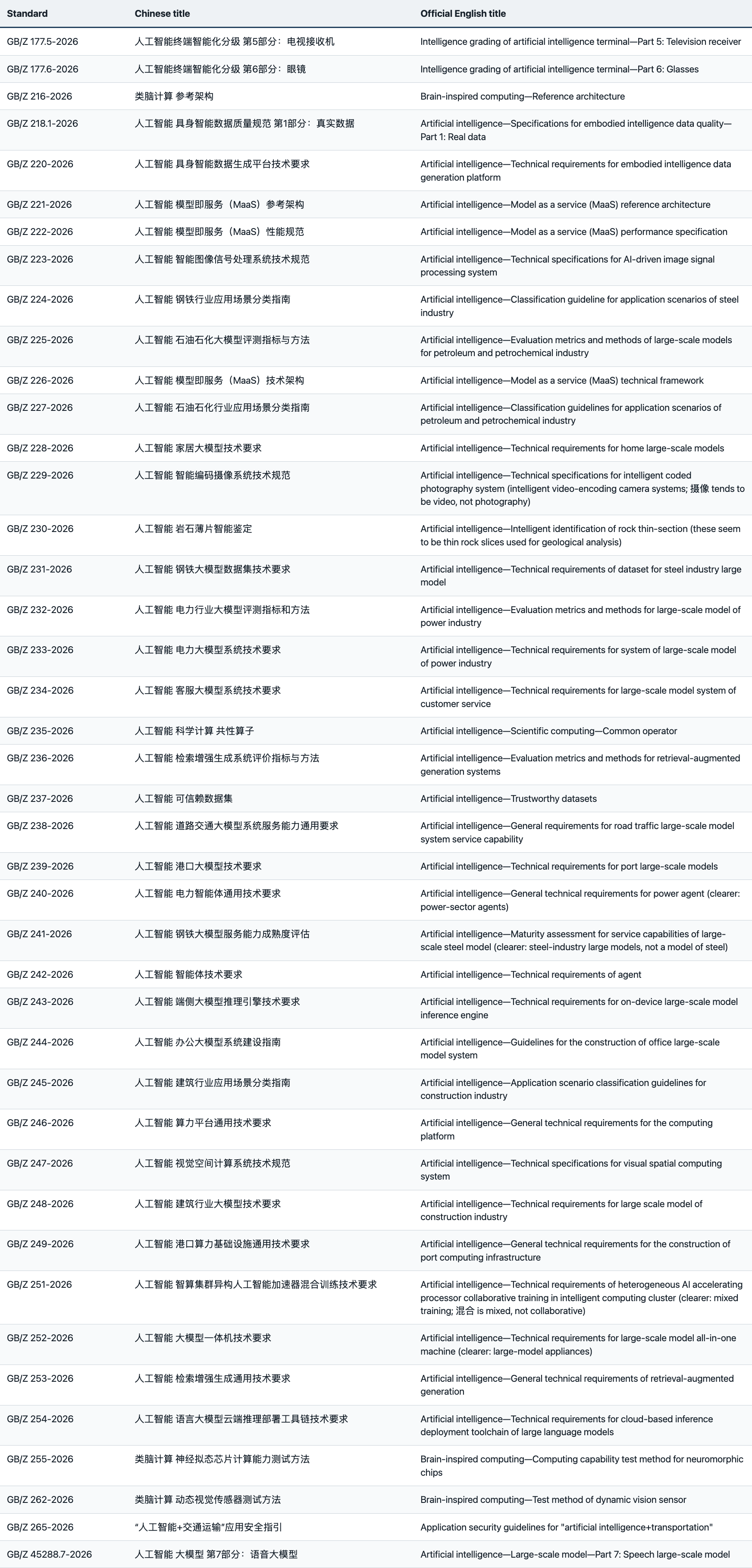
The SAC publishes 42 nonbinding AI technical documents
The Standardization Administration of China (SAC) posted an August 27 announcement approving 60 national standardization guiding technical documents on September 3.10 Forty-two concern AI or brain-inspired computing.
GB/Z documents are nonbinding national guidance. They provide reference architectures, technical requirements, and evaluation methods but do not require firms to comply. This batch therefore expands the technical framework for AI deployment without creating new regulatory obligations.
A large number of the documents concerns deployment in individual industries. The documents cover large-model systems, datasets, agents, or application scenarios in steel, power, oil and petrochemicals, ports, construction, road transport, home products, customer service, and offices. A second group covers compute and deployment, including compute platforms, on-device inference, cloud toolchains, model appliances, port compute infrastructure, and mixed training on heterogeneous accelerators. The horizontal documents address agents, retrieval-augmented generation, trustworthy datasets, Model as a Service, and embodied intelligence data. Notable guides include GB/Z 242-2026, which sets general technical requirements for agents, and GB/Z 236-2026, which provides evaluation guidance for RAG systems.
The table uses the official English titles from the standards records. Parenthetical notes clarify translations that may be unintuitive to an English reader.
TC260 proposes a five-level AI security benchmark
The National Technical Committee on Cybersecurity Standardization (TC260) invited public comment on its draft AI Security Capability Maturity Assessment Method on August 26, with comments due October 25.11 TC260 previously assigned experts and editors to the batch containing it.
The draft assesses organizations across 39 process areas and 15 activities in the data, model, and application lifecycles. Its 10 dimensions combine organizational measures, such as staffing and internal processes, with technical measures, including robustness, explainability, fairness, data protection, rights protection, and emerging-risk controls. Five maturity levels range from ad hoc execution through planning and quantitative control to continuous improvement. The draft also says regulators could use the method when evaluating organizations. A maturity score would measure how systematically an organization manages AI risk; it would not, by itself, establish that a model is safe.
Three other drafts with AI relevance are open for comment.

The SAMR registers more ethics-review standards projects
SAMR registered nine AI standards projects on September 1. Three would standardize ethics review institutions or procedures; the other six would apply AI standards to specific industries or amend an accelerator-interface document. They follow the three ethics governance projects TC28/SC42 registered in May, which cover scenario classification and grading, ethics risk assessment, and technical skill requirements for review personnel.
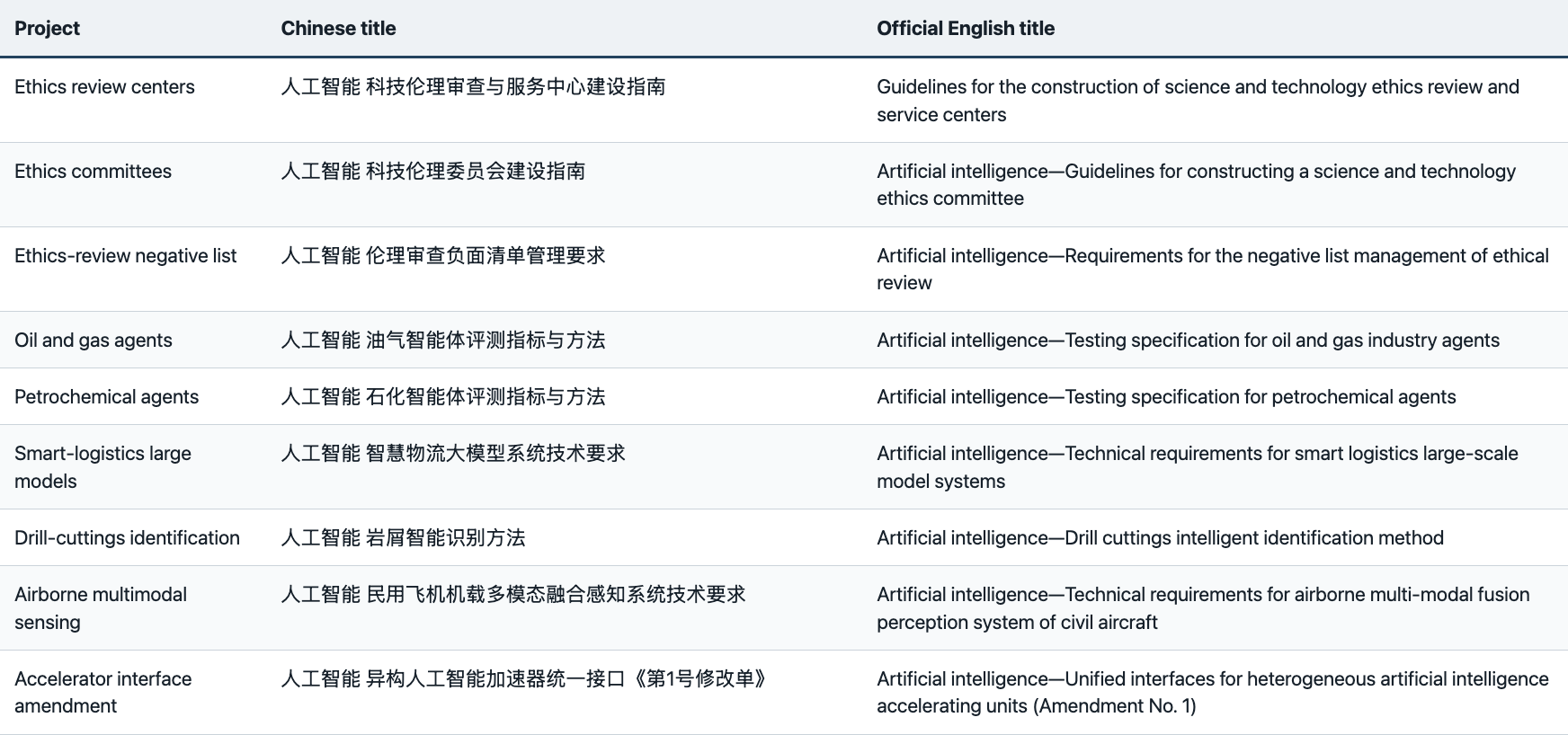
Registration authorizes drafting; the SAMR has not published text for any of the nine projects. The two institution-building guides would supply templates for bodies that already have a legal basis. Under the Trial Measures for AI Science and Technology Ethics Review and Services,12 which 10 departments including the CAC released on April 2, every university, research institute, medical institution, and enterprise conducting AI research or development is responsible for reviewing its own activities and must establish an AI ethics committee (Art. 9). An entity with no committee, or whose committee cannot do the work, has to commission a third-party review and service center, which local authorities and departments may establish (Art. 11). Reviews examine six areas (Art. 15), including whether a model stays robust in open environments and extreme conditions, and whether users can control, guide, and intervene in its basic operation.
This is the part of China’s AI rules that reaches research and development rather than deployment—if something is already subject to filing or approval under other regulations that include ethics requirement, no expert re-review is required—and MIIT and the Ministry of Science and Technology administer it rather than the CAC. The 10-province pilot from Issue 4 ends November 30, and its targets include validating and formulating five or more standards, so this may be part of the pilot.
It’s less clear what the negative list project is for. The Measures already provide for a list of AI activities requiring expert ethics re-review, formulated by MIIT and the Ministry of Science and Technology and adjusted as needed (Art. 21). Activities on that list go to expert re-review after passing internal review, and face follow-up review at least every six months (Arts. 22 and 25); the pilot asks provincial authorities to propose updates to it. The SAMR project is titled 负面清单 (negative list) rather than the Measures’ 复核清单 (re-review list), and the registration does not say whether the two are the same list. As a guiding technical document, it would at most offer guidance on managing a list rather than create one. The drafters are Renmin University of China, the China Electronics Standardization Institute, and Peking University, on a nine-month cycle.
Other standards news
The China Academy of Information and Communications Technology (CAICT) publicized YD/T 7112-2026, on image-dataset quality assessment, on September 8 and YD/T 7113-2026, on speech-dataset quality assessment, on September 4.13 The MIIT approved YD/T 7112 on July 24, and it takes effect November 1; the approval date for YD/T 7113 remains unverified. These are recommended industry standards. Their September publicity continues the rollout of the July batch from which Issue 9 covered eight other standards.
TC260 is seeking new members after completing its third five-year term, but it’s unclear whether or how much its membership or leadership will change.
CAICT’s September 4 report on Study Group 17 of the International Telecommunication Union Telecommunication Standardization Sector (ITU-T SG17) says the meeting addressed agent security and coordination among international standards bodies.
CAICT announced a September 10 symposium on its agent harness engineering standards work. The planned specification covers task orchestration, tool use, execution, and feedback loops; drafting began in August.
The AI Industry Alliance’s safety governance committee agreed on the structure of a token security technical specification14 on September 4. The proposed framework covers agent interactions, model-provider billing and routing, compute isolation, and token management. The committee identified credential theft, cross-session or cross-tenant memory pollution, and compute exhaustion as risks.
On the Horizon
CAC Spokesperson Wang Lihong said the agency will publish version 3.0 of the AI Safety Governance Framework during National Cybersecurity Awareness Week, which runs September 14–20.15
For more on how we select and track content, see our methodology here.
The China AI Bulletin is maintained by the Safe AI Forum (SAIF), a US 501(c)3 facilitating international cooperation on extreme AI risks. Views expressed represent individual authors’ perspectives, not official SAIF positions.
The China AI Bulletin is copy-edited and fact-checked by Kacie Yearout, Pivotal fellow and former diplomat.
Wang’s five headings included “模型能力跃迁颠覆传统安全范式,极端失控风险显现” and “全球人工智能领域面临技术霸权风险.”
TC260-PG-20267A, Section 6(a).
毛宁:“中国人工智能发展是高水平科技自立自强的成果……我们希望美方能够认真落实两国元首达成的重要共识,不要对中国进行不实的指责和抹黑,中美都是人工智能大国,应当加强合作。”
“会议在人工智能和新兴技术创新政策原则、提升劳动者人工智能技能等方面达成诸多共识.”
“支持联合国在相关标准制定中的主渠道地位”; “开源开放是人工智能发展的内在基因,也是弥合‘数智鸿沟’的有效途径.”
The OSTP leads much of the US’s AI policy, including the 2025 AI Action Plan.
Yuyuan Tantian (玉渊谭天) is an unofficial CCTV account under China Media Group. It began during the first US–China trade war as an outlet for ideas that official state media could not publish directly. The source describes it as “light cavalry” (轻骑兵) for promoting new ideas. Geopolitechs provides an English translation of the commentary.
《Anthropic得了美国病》
Huawei’s terms, per Science and Technology Daily: Agent亲和系统架构 (agent-affinity system architecture) and 从“人找应用”到“意图即服务” (from “people looking for applications” to “intent as a service”).
《关于批准发布〈人工智能 具身智能数据质量规范 第1部分:真实数据〉等60项国家标准化指导性技术文件的公告》, 国家标准公告2026年第37号.
《网络安全技术 人工智能安全能力成熟度评估方法》.
《人工智能科技伦理审查与服务办法(试行)》, 工信部联科〔2026〕75号
《YD/T 7112—2026 人工智能 关键基础技术 图像数据集质量评估要求》 and 《YD/T 7113—2026 人工智能 关键基础技术 语音数据集质量评估要求》.
《Token安全防护产品能力要求》
TC260 issued the first two versions as nonbinding technical documents under the CAC’s guidance. Version 3.0 will show whether the CAC carries the September 1 references to extreme loss of control, frontier model safety evaluations, and biology/genetics into a structured risk framework—and whether it pairs them with specific evaluations or risk-reduction measures.
Another typically excellent bulletin. Thanks for all the hard work you guys do
Another marvel!